Research Objective
Understanding the fashion consumption behaviour of Gen-Z to trigger a behavioural shift towards responsible habits.
Focus on gaining insights into Gen-Z preferences, behaviours and decision-making processes in the fashion industry with a focus on responsible fashion consumption.
Research Questions
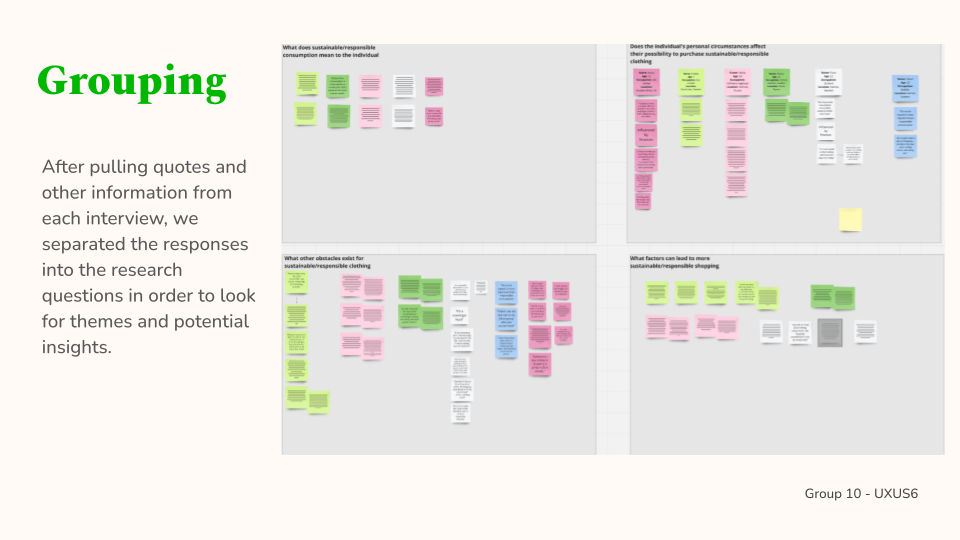
1. What does sustainable/responsible consumption mean to the individual?
2. Does the individual’s circumstances affect their possibility to purchase sustainable clothing?
3. What other obstacles exist for responsible consumption?
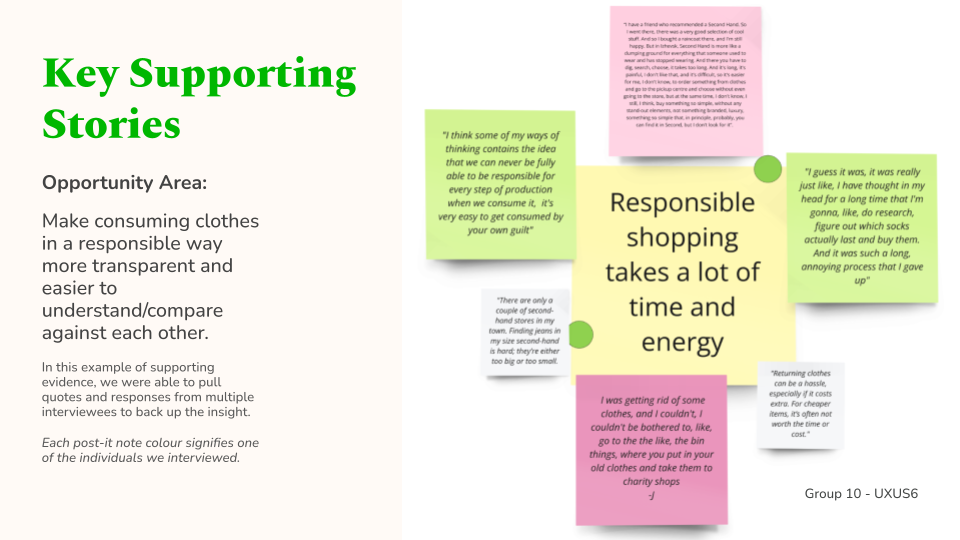
4. What are factors that make sustainable consumption easier?
2. Does the individual’s circumstances affect their possibility to purchase sustainable clothing?
3. What other obstacles exist for responsible consumption?
4. What are factors that make sustainable consumption easier?
Interview Questions
1. What is your definition of sustainable consumption?
2. Can you give some examples of sustainable shopping?
3. What does your life look like at the moment?
4. Are you currently employed?
5. Based on your answers to the previous question and your definition of sustainable consumption, would you be more or less likely to purchase sustainable clothing, through for example second hand stores, or would you be more or less likely to purchase more expensive and possibly less sustainable clothing?
6. If you think back on your clothing consumption from today and a year back, can you recall any time that you purchased something that in your view was not a responsible buy?
7. Do you remember what influenced your decision that time?
If you think back about your cloth consumption, what would you consider to be the biggest obstacle to responsible consumption?
8. What applications do you know about or use to buy second hand clothing?
9. What physical shops do you visit and are there enough near your location?
10. How many of your friends do the same?
11. Do you watch any influencers that talk about sustainable fashion?
2. Can you give some examples of sustainable shopping?
3. What does your life look like at the moment?
4. Are you currently employed?
5. Based on your answers to the previous question and your definition of sustainable consumption, would you be more or less likely to purchase sustainable clothing, through for example second hand stores, or would you be more or less likely to purchase more expensive and possibly less sustainable clothing?
6. If you think back on your clothing consumption from today and a year back, can you recall any time that you purchased something that in your view was not a responsible buy?
7. Do you remember what influenced your decision that time?
If you think back about your cloth consumption, what would you consider to be the biggest obstacle to responsible consumption?
8. What applications do you know about or use to buy second hand clothing?
9. What physical shops do you visit and are there enough near your location?
10. How many of your friends do the same?
11. Do you watch any influencers that talk about sustainable fashion?
Research Plan
Our group conducted in-depth interviews with 6 individuals, aged 22-24:
Freddie, age 24 from Stockholm, Sweden
Sasha, age 24 from Izhevsk, Russia
Alexey, age 22 from Omsk, Russia
Tove, age 22 from Kalmar, Sweden
Oscar, age 22 from Kalmar, Sweden
Jenny, age 22 from Huddersfield, UK
*Names have been anonymised.
Sasha, age 24 from Izhevsk, Russia
Alexey, age 22 from Omsk, Russia
Tove, age 22 from Kalmar, Sweden
Oscar, age 22 from Kalmar, Sweden
Jenny, age 22 from Huddersfield, UK
*Names have been anonymised.
Interview Structure
5 min: Introduction, IDOARRT, Check-in
20-25 min: Research questions and conversation between interviewer and interviewee.
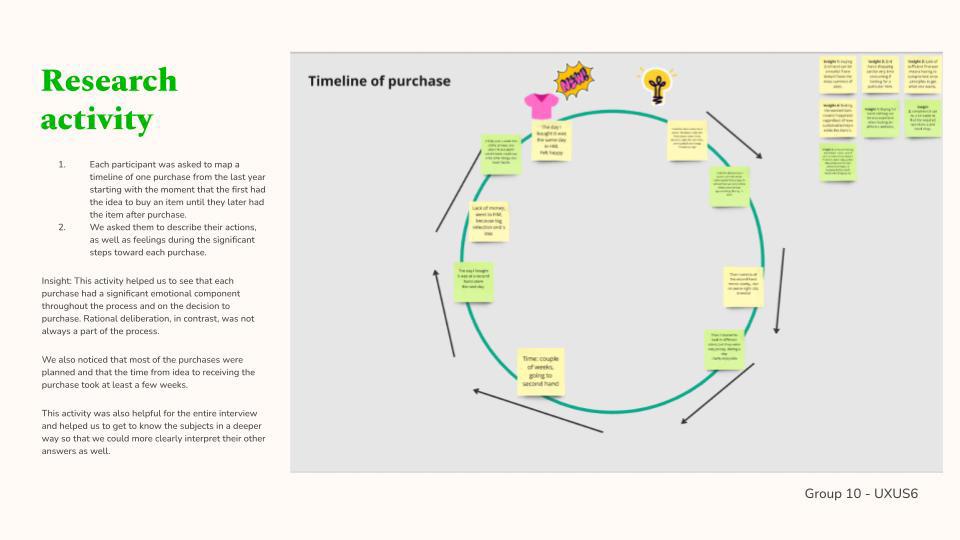
10 min: Purchase timeline activity on Miro-board.
5 min: Wrap-up and checkout.
Our interviews were conducted via Zoom and we used an AI-tool to record and transcribe our interviews.
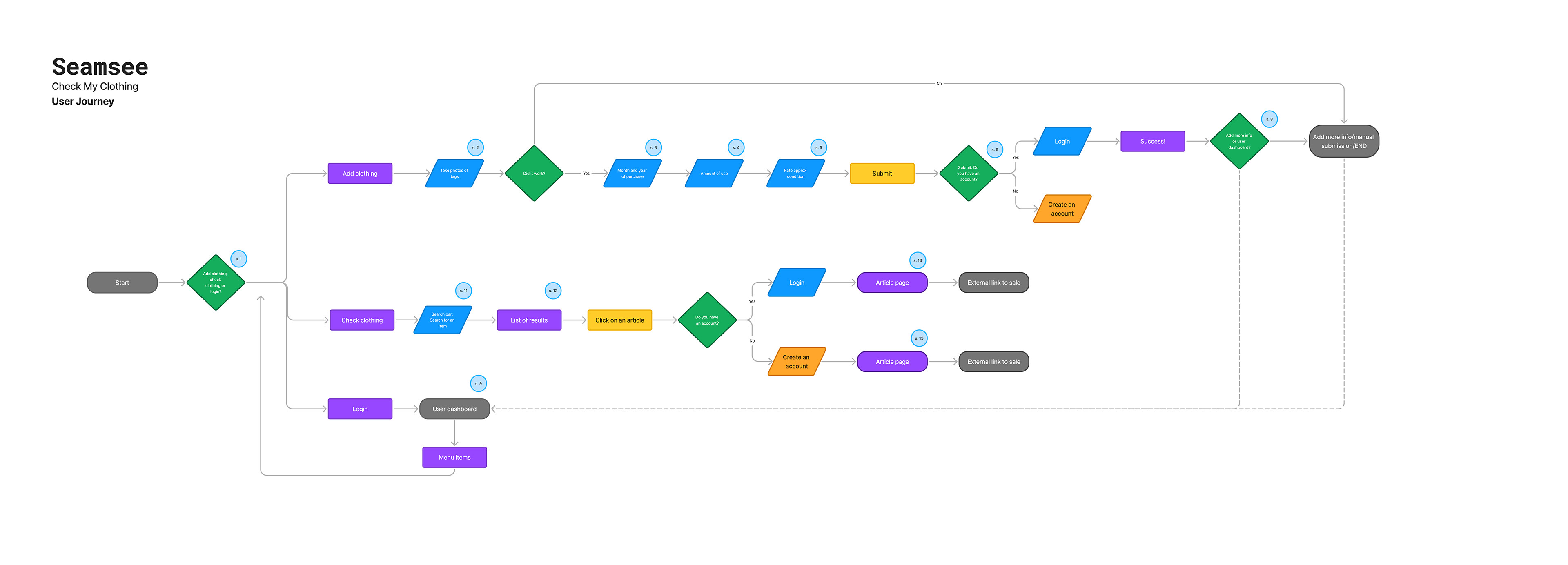
Next steps: Idea for a new app that helps users to know more about their clothing before making a purchase